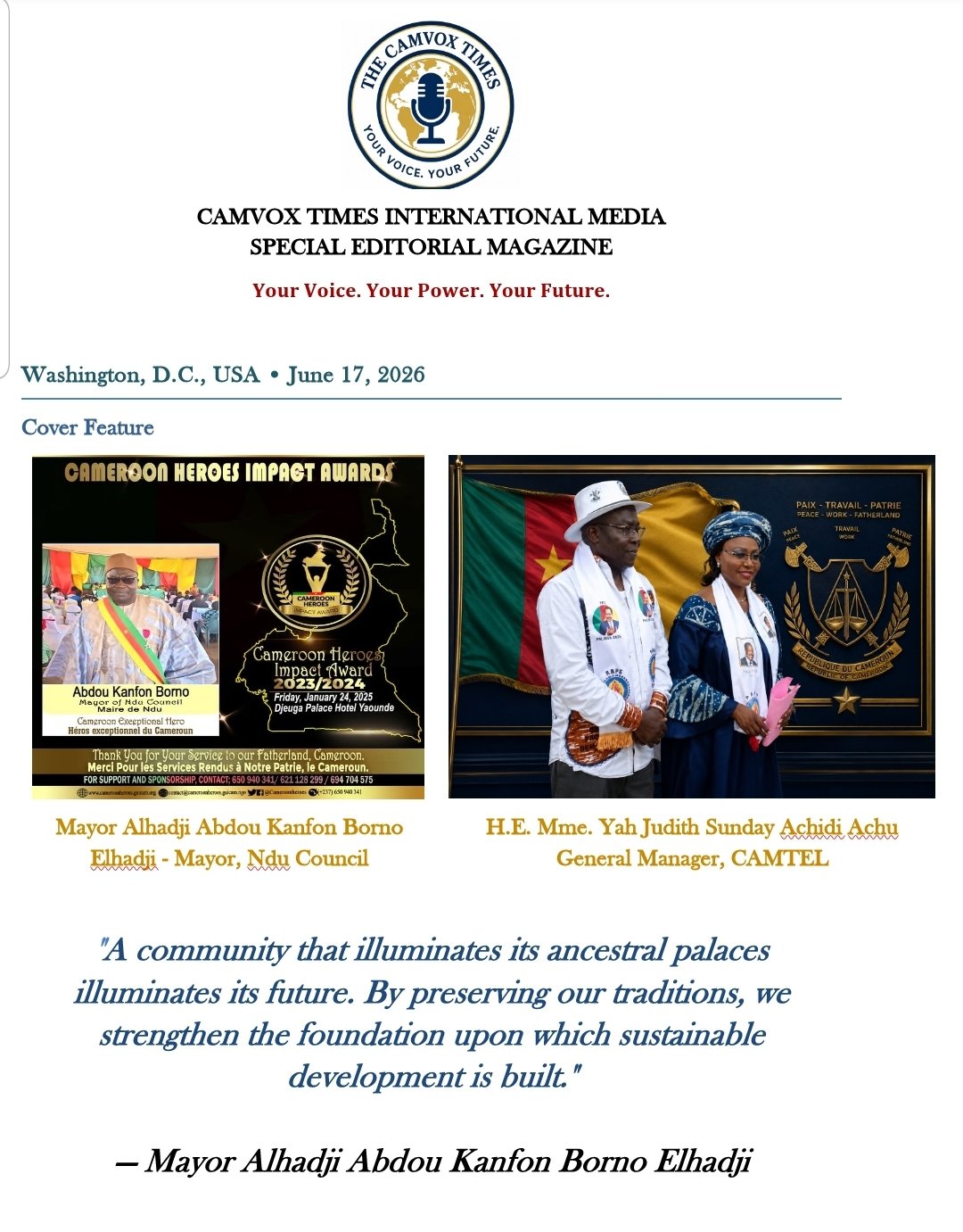
How Mayor Abdou Kanfon Borno Is Preserving Ndu’s Ancestral Heritage
ILLUMINATING TRADITION:
For many communities, modernization often comes at the expense of tradition. But in the Municipality of Ndu, Cameroon, a different story is unfolding.
"The lights now shining in the ancestral palaces of Ndu illuminate more than buildings; they illuminate a vision of development that respects the past, serves the present, and prepares confidently for the future."
In this special investigative editorial by CamVox Times International Media, Government Expert Laura Jacobson examines how Mayor Alhadji Abdou Kanfon Borno Elhadji is leading one of the most innovative cultural preservation initiatives in Cameroon.
Through the electrification, renovation, and rehabilitation of traditional palaces, the Ndu Council is demonstrating that development and cultural heritage can thrive together.
This report explores:
✅ Solar electrification of traditional palaces
✅ Preservation of ancestral institutions
✅ Renovation and rehabilitation of cultural landmarks
✅ Collaboration between Ndu Council and traditional authorities
✅ The role of the 17 Fons and 11 Ardos in community development
✅ Peacebuilding and restoration of normalcy in Ndu Sub-Division
✅ The vision of Mayor Abdou Kanfon Borno for sustainable local governance
This report provides a rare look at how local government, traditional leadership, and community stakeholders are working together to preserve Ndu's rich cultural heritage while embracing modern development.
BACKGROUND INTRODUCTION.
Nestled among the rolling hills and mist-covered highlands of Cameroon’s North West Region lies Ndu, a land where nature and history seem to converse in whispers carried by the mountain winds. Here, emerald-green valley’s stretch toward the horizon, crystal-clear streams weave through fertile farmlands, and towering eucalyptus forests stand guarding over communities whose stories span centuries. At dawn, sunlight spills gently across the landscape, illuminating traditional compounds, grazing fields, and ancestral palaces that have served as the spiritual and cultural heartbeat of the people for generations.
Ndu is more than a geographical location. It is a living museum of culture, tradition, resilience, and communal identity. The rhythms of daily life are intertwined with customs passed down through countless generations. Traditional rulers continue to command profound respect.
Ancient ceremonies remain vibrant expressions of community life. The wisdom of elders is preserved alongside the aspirations of a younger generation eager to embrace the opportunities of the modern world.
Yet as one travels through this remarkable municipality today, something extraordinary becomes immediately apparent.
As darkness descends over the hills and valleys of Ndu, lights begin to appear where, only a few years ago, there was darkness. Solar-powered lamps now illuminate the courtyards of ancestral palaces. Renovated traditional structures stand proudly against the evening sky. Community members gather beneath modern lighting systems installed within institutions that have served as guardians of culture for centuries.
How did one of Cameroon’s most tradition-rich municipalities become a model for preserving heritage through innovation?
How did a local council succeed where many development programs across Africa have struggled—proving that modernization does not have to erase cultural identity?
And what can the rest of Cameroon learn from a municipality that has found a way to honor its past while preparing confidently for its future?
The answers lie in the vision, leadership, and collaborative approach of Mayor Alhadji Abdou Kanfon Borno Elhadji, whose administration has embarked upon one of the most ambitious cultural preservation initiatives in the North West Region.
In many parts of Africa, modernization and tradition are often portrayed as competing forces. Policymakers frequently face the difficult challenge of balancing economic development with the preservation of cultural identity. Yet in the Municipality of Ndu, a different story is unfolding—one that demonstrates that progress and tradition can not only coexist but thrive together.
Under the leadership of Mayor Alhadji Abdou Kanfon Borno Elhadji, Ndu Council has launched an innovative program aimed at electrifying, rehabilitating, and revitalizing the ancestral palaces that serve as the historic heart of the community. These projects represent far more than infrastructure investments. They symbolize a profound commitment to preserving the institutions, customs, and heritage that define the identity of the people of Ndu.
PRESERVING THE PAST WHILE BUILDING THE FUTURE.
Throughout Africa, policymakers and development practitioners often face a recurring challenge: how to promote modernization and economic growth without eroding the cultural values and traditional institutions that have shaped communities for generations. In many places, modernization is viewed as a force that inevitably weakens tradition. New technologies, changing lifestyles, and rapid urbanization can sometimes create the impression that cultural heritage must give way to progress.
In the Municipality of Ndu, however, a different model is emerging—one that demonstrates that development and tradition are not mutually exclusive. Under the leadership of Mayor Alhadji Abdou Kanfon Borno Elhadji, Ndu Council has embraced a development philosophy that recognizes culture as an asset rather than an obstacle. The municipality has launched one of the most ambitious cultural preservation programs in the North West Region, focusing on the electrification, renovation, and rehabilitation of ancestral palaces throughout the Ndu Sub-Division.
These initiatives represent far more than construction projects or infrastructure investments. They reflect a deliberate effort to preserve the institutions that embody the history, identity, and collective memory of the people of Ndu. By investing in traditional institutions, the Council is helping ensure that future generations remain connected to their heritage while participating fully in the opportunities of the modern world.
WHERE TRADITION MEETS INNOVATION.
For centuries, the palaces of the various Fons of Ndu have served as the centerpieces of community life. These institutions have historically functioned as seats of governance, centers of justice, repositories of cultural knowledge, and symbols of communal unity. They remain places where important decisions are made, disputes are resolved, cultural ceremonies are conducted, and ancestral traditions are preserved.
In many communities, traditional institutions continue to play an indispensable role in maintaining social harmony and transmitting cultural values from one generation to the next. Recognizing this reality, Mayor Abdou Kanfon Borno concluded that preserving these institutions required more than symbolic recognition. It required practical investment and modernization that would allow them to remain functional and relevant in the twenty-first century.
Rather than viewing technology as a threat to tradition, the mayor adopted an innovative approach that uses modern solutions to strengthen traditional governance. This philosophy gave rise to what many residents now proudly describe as the "Solar Revolution of the Palaces." Through this initiative, the Ndu Council has introduced solar-powered electrification to several of the municipality's most important traditional institutions, ensuring that they continue to serve their communities effectively while maintaining their cultural significance.
LIGHTING THE FOUNDATIONS OF CULTURAL HERITAGE
One of the most visible achievements of this initiative has been the successful installation of solar energy systems in several ancestral palaces across the municipality. These projects have brought reliable, clean, and sustainable energy to institutions that serve as the custodians of Ndu's cultural heritage.
The solar electrification program has benefited the palaces of:
• The Fon of Ndu
• The Fon of Ntumbaw
• The Fon of Talla
• The Fon of Ntundip
• The Fon of Ngarum
• The Fon of Mbipgo
• The Fon of Sinna
• The Fon of Wowo
The impact of these installations extends far beyond the provision of electricity. In practical terms, they have transformed how these institutions function. Traditional council meetings can now continue after sunset without interruption. Community consultations and conflict-resolution sessions can take place under reliable lighting conditions. Cultural ceremonies and festivals can be conducted more safely and efficiently. Administrative activities that support local governance can also be performed more effectively.
Perhaps most importantly, these improvements have helped bridge the gap between generations. Younger members of the community increasingly view the palaces as active and relevant institutions rather than relics of the past. By integrating modern technology into traditional spaces, the Council has demonstrated that cultural preservation and modernization can complement one another rather than compete.
RESTORING THE SYMBOLS OF COMMUNITY IDENTITY
The Council's commitment to cultural preservation extends well beyond electrification. Recognizing that many ancestral palaces face challenges associated with age, weather, and limited maintenance resources, Mayor Abdou Kanfon Borno's administration has undertaken an extensive program of renovation and rehabilitation aimed at preserving these important landmarks.
The rationale behind these investments is straightforward. The physical structures of the palaces are not merely buildings; they are living symbols of the community's history and identity. When these structures deteriorate, communities risk losing tangible connections to their heritage.
As part of this effort, the palaces of Ngarum, Nsehmakop, and Ngvulu have undergone significant renovation works designed to restore their appearance, improve their functionality, and ensure their continued use by future generations. These projects have helped revitalize structures that hold immense historical and cultural significance for the communities they serve.
In addition, the palaces of Njilah and Sinna have benefited from rehabilitation projects focused on structural improvements, safety enhancements, and aesthetic restoration. Care has been taken to preserve the traditional architectural character of these institutions while ensuring that they remain functional and resilient.
These interventions reflect a broader understanding that cultural heritage must be actively maintained if it is to survive. Preservation is not achieved simply by celebrating history; it requires sustained investment in the institutions that embody that history.
"ONLY IN NDU COUNCIL"
Among residents of Ndu, one phrase frequently emerges when discussing these initiatives:
"Only in Ndu Council."
This phrase has become a source of local pride and reflects the perception that the municipality has adopted a uniquely proactive approach to cultural preservation. For many citizens, the palace electrification and rehabilitation projects symbolize a model of governance in which traditional authorities are treated as genuine development partners rather than ceremonial figures.
By investing directly in the institutions of the Fons, the Council has reinforced the role of traditional rulers as important contributors to community development, social stability, and cultural continuity. This approach recognizes that traditional authorities possess valuable local knowledge, influence, and legitimacy that can complement formal government institutions.
The initiative has also strengthened cooperation between the municipal administration and traditional leadership structures. This partnership has created new opportunities for collaboration on community development projects and has fostered a shared sense of responsibility for preserving the cultural heritage of the municipality.
A PHILOSOPHY OF SERVANT LEADERSHIP
At the heart of these achievements lies a broader philosophy that has come to characterize Mayor Abdou Kanfon Borno's approach to governance. His administration embraces the principles of servant leadership, a model that views leadership not as the exercise of authority over people but as a responsibility to serve them.
Under this philosophy, development is not measured solely by roads constructed, budgets managed, or infrastructure completed. While these indicators remain important, true development also involves protecting the values, traditions, and institutions that give communities their identity and sense of belonging.
The palace electrification and rehabilitation initiative provides a clear example of this philosophy in practice. Rather than treating cultural preservation as separate from development, the administration has integrated the two. The result is a model of governance that seeks to improve living standards while simultaneously protecting the heritage that defines the community.
This approach reflects a broader understanding that sustainable development must be rooted in local realities and cultural values if it is to achieve lasting success.
PARTNERSHIPS THAT MAKE PROGRESS POSSIBLE
The success of these projects has depended on strong partnerships among multiple stakeholders. Traditional rulers, community leaders, development partners, residents, and distinguished sons and daughters of Ndu have all played important roles in supporting the municipality's cultural preservation efforts.
Among the notable supporters of development initiatives within the municipality is Her Excellency Mme. Yah Judith Achidi Achu, General Manager of CAMTEL. Her commitment to public service and community advancement reflects the important role that accomplished citizens can play in supporting local development efforts and strengthening community institutions.
The collaboration between the Ndu Council, traditional authorities, development stakeholders, and community leaders demonstrates an important lesson: sustainable progress is most effective when diverse institutions work together toward common goals. The success of the palace preservation program serves as a powerful example of what can be achieved through cooperation, shared vision, and collective responsibility.
BUILDING THE FUTURE BY HONORING THE PAST
As Ndu continues to pursue its development agenda, the illuminated and restored palaces scattered throughout the municipality stand as powerful symbols of continuity, resilience, and hope. They remind residents that modernization does not require abandoning the traditions and institutions that have sustained communities for generations.
Instead, the experience of Ndu demonstrates that genuine development is achieved when communities embrace innovation while preserving the values and heritage that define them. The palace electrification and rehabilitation initiative shows that cultural preservation can be an integral part of a broader development strategy rather than an afterthought.
For many residents, these projects may become one of the most enduring legacies of Mayor Abdou Kanfon Borno's administration. Not because they introduced electricity or renovated buildings, but because they reinforced the idea that cultural identity remains essential to sustainable development.
Today, the ancestral palaces of Ndu shine brighter than they have in decades. Yet their significance extends beyond the light that illuminates their walls. They illuminate a vision of leadership that respects the past, serves the present, and prepares confidently for the future.
Coming Next in the CamVox Times Special Editorial Series
Water for the People: How Ndu Council's Community Water Projects Are Transforming Lives Across the Municipality
In our next feature, we examine how Ndu Council's expanding water infrastructure projects are improving public health, supporting economic development, reducing hardship for families, and enhancing the quality of life for communities throughout the municipality.
CAMVOX TIMES INTERNATIONAL MEDIA
Your Voice. Your Power. Your Future.
Prepared by the Editorial Board of CamVox Times International Media
Under the Supervision of Dr. Julius Babila Taka.
Director of Publications
Washington, D.C., United States of America