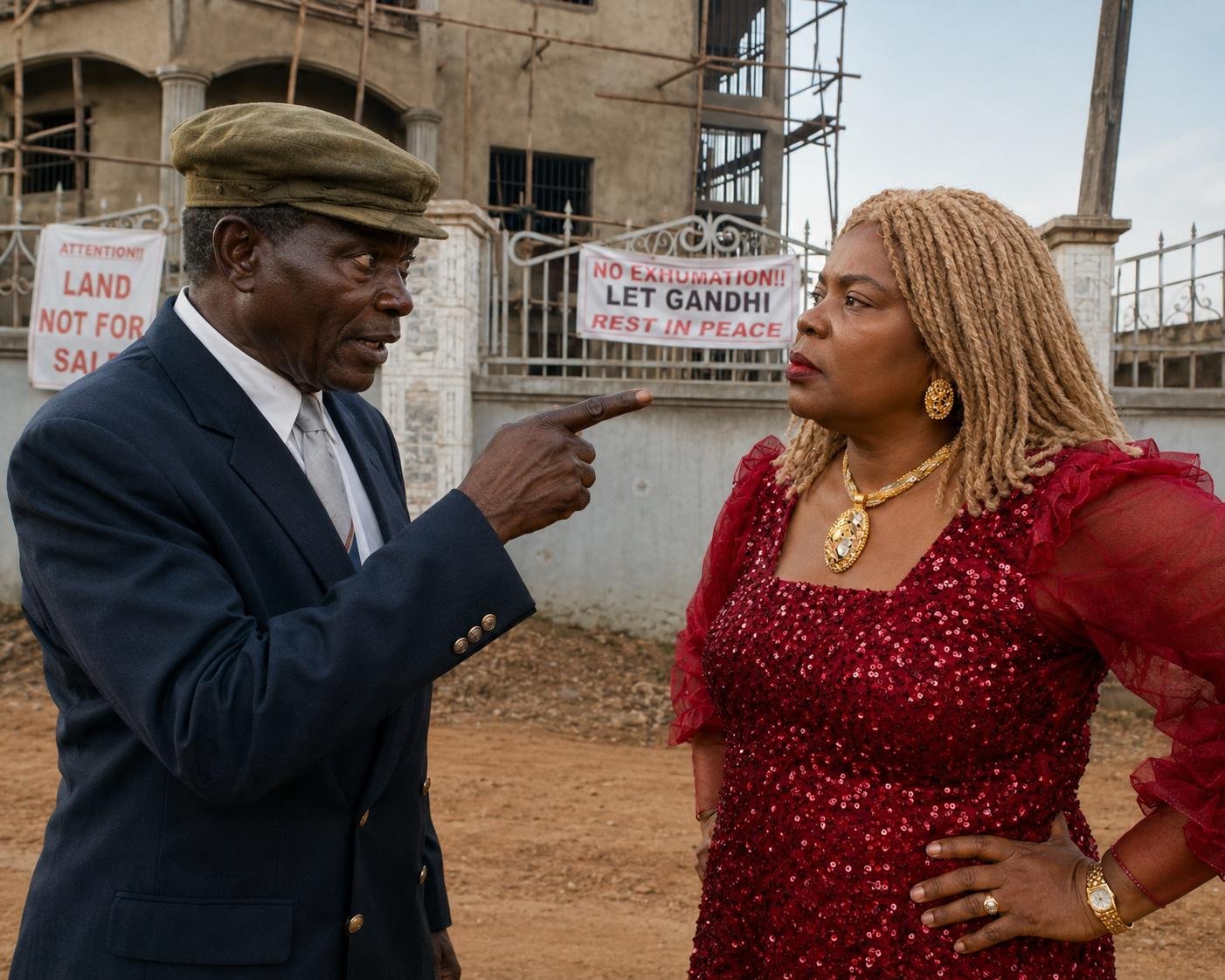
THE WIDOW, THE GRAVE AND THE LAND CERTIFICATE. (The memorial statue of the late Che Ngwa Gandhi, erected by his family at the disputed Gandhi Compound in Big Mankon (Atuazire), Bamenda. According to family members, the site has served as both a family residence and a place of remembrance for more than three decades)

THE CAMVOX TIMES INTERNATIONAL MEDIA
Your Voice. Your Power. Your Future.
SPECIAL INVESTIGATIVE REPORT
THE WIDOW, THE GRAVE, AND THE LAND CERTIFICATE
How the Gandhi Compound Became One of Bamenda’s Most Controversial Property Disputes. By Dr. Julius Babila Taka, PhD Director of Publications
CamVox Times International Media
Washington, D.C., USA
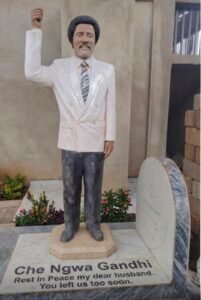
The memorial statue of the late Che Ngwa Gandhi, erected by his family at the disputed Gandhi Compound in Big Mankon (Atuazire), Bamenda. According to family members, the site has served as both a family residence and a place of remembrance for more than three decades.
A Widow’s Long Journey Through the Courts
For Dr. Anna Nkapsah Nji, a Cameroonian professional residing in Maryland, USA, the dispute over the Gandhi Compound is not merely about ownership of land.
It is about the memory of a husband.
It is about the future of children who lost their father while still young.
It is about a home allegedly built through years of sacrifice.
It is about family heritage.
And perhaps most importantly, it is about the final resting place of loved ones.
According to court filings, petitions, administrative correspondence, and legal notices reviewed by CamVox Times International Media, the dispute has evolved over several years into one of the most emotionally charged inheritance and property controversies currently attracting public attention in the North West Region of Cameroon.
At the center of the controversy are: Principal Parties
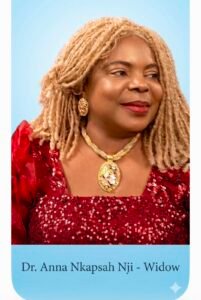
Dr. Anna Nkapsah Nji
Widow of the late Che Ngwa Gandhi
Petitioner and Administratrix of the Estate
Late Che Ngwa Gandhi
Former occupant and alleged beneficiary of the disputed property
Che Ngwa Chofor Asanji
Son of the late Che Ngwa Gandhi
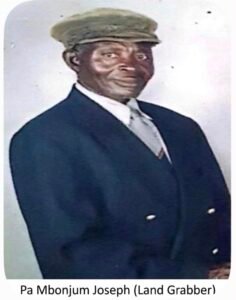
Joseph Mbonjum
Claimant to the estate of the late Mama Margaret Ngwencho
Barrister Muluh Stanly
Legal counsel identified in multiple petitions and legal notices connected to the dispute
Justice Kwende Chantal
Judge of the High Court of Mezam referenced in petitions submitted by the widow
The Land Registrar, Mezam Division
Public official whose actions are challenged in several petitions reviewed by this publication
THE ORIGIN OF THE PROPERTY
According to petitions submitted by Dr. Anna Nkapsah Nji and her legal representatives, the property traces its origins to the late Mama Margaret Ngwencho of Big Mankon.
The widow maintains that Mama Margaret Ngwencho traditionally adopted Che Ngwa Gandhi as her son and entrusted him with the property that would later become known as the Gandhi Compound.
The family further alleges that before her death, Mama Margaret Ngwencho gifted the property to Che Ngwa Chofor Asanji, son of the late Che Ngwa Gandhi.
The property subsequently became the family’s principal residence.
According to the documents reviewed, Che Ngwa Gandhi constructed residential buildings on the land and occupied the premises with his wife and children.
The family asserts that they lived peacefully on the property for decades
THE DEATH OF CHE NGWA GANDHI
According to family records and petitions submitted by the widow, Che Ngwa Gandhi died in the early 1990s.
At the time of his death, his children were still minors.
The widow subsequently obtained Letters of Administration over his estate through the same legal system whose actions she now challenges.
The family continued residing on the property.
The widow states that she invested significant resources earned while living and working abroad to maintain and improve the compound.
According to her petitions, the property eventually grew to include substantial structures worth hundreds of millions of francs CFA.
THE BURIALS THAT CHANGED EVERYTHING
One of the most sensitive aspects of the dispute concerns burial sites located on the property.
According to the family:
* Che Ngwa Gandhi was buried on the land.
* Mama Margaret Ngwencho was later buried on the same property.
The graves transformed the site from merely a residential compound into a place of family memory and spiritual significance.
For more than thirty years, according to the family, these graves remained undisturbed.
The grave and memorial monument of the late Che Ngwa Gandhi at the disputed Gandhi Compound in Bamenda. The possibility of relocation of the graves has become one of the most controversial aspects of the dispute.
THE EMERGENCE OF A COMPETING CLAIM
According to petitions filed by Dr. Anna Nkapsah Nji, the controversy intensified following the death of Mama Margaret Ngwencho in 2008.
The widow alleges that Joseph Mbonjum subsequently emerged claiming inheritance rights over the estate.
According to the petitions:
* Letters of Administration were obtained.
* Control was allegedly asserted over properties associated with the estate.
* Ownership claims extended to the Gandhi Compound.
The widow disputes those claims and maintains that the property had already been gifted to her family.
CASE HCMB/PD/LA.09/2023
A major turning point occurred in 2023.
According to court documents referenced in multiple petitions, Dr. Anna Nkapsah Nji initiated proceedings before the High Court of Mezam under:
HCMB/PD/LA.09/2023
The purpose of the action, according to the petitioners, was to challenge competing ownership claims and address questions concerning the administration of the estate.
The widow maintains that the case has remained pending for years, with multiple adjournments.
ALLEGATIONS AGAINST JUSTICE KWENDE CHANTAL
Perhaps the most explosive aspect of the controversy appears in a petition addressed to the President of the North West Court of Appeal.
In that petition, Dr. Anna Nkapsah Nji alleges bias and unfair treatment by Justice Kwende Chantal.
The widow claims that while the substantive ownership dispute remained pending before the High Court, a separate ex parte proceeding concerning the same property was entertained.
The petition further alleges that orders arising from those proceedings facilitated the transfer of the disputed land certificate.
Justice Kwende Chantal has not publicly responded to these allegations in the documents reviewed by CamVox Times.
No competent judicial authority has made findings regarding these allegations.
Nonetheless, the claims form a significant part of the widow’s continuing campaign for judicial review.
THE CONTROVERSIAL LAND CERTIFICATE
At the center of the controversy is:
Land Certificate No. 5638
Volume 28
Mezam Division
The widow maintains that she possesses the original certificate.
Yet according to petitions submitted to multiple authorities, ownership of the certificate was subsequently transferred.
The petitioners allege that:
* The transfer occurred despite pending litigation.
* Administrative authorities were aware of ongoing court proceedings.
* Subsequent transfers were made to corporate entities.
These allegations remain matters for judicial determination.
STAR BUSINESS CONSULTING LIMITED AND MAF HOLDING INCORPORATION LIMITED
The dispute escalated further when ownership interests allegedly moved beyond private individuals.
Documents reviewed by CamVox Times identify:
Star Business Consulting Limited
and
MAF Holding Incorporation Limited
as entities associated with subsequent transfers of the disputed property.
The widow’s petitions question the circumstances surrounding these transfers and call for official investigations.
THE NOTICE THAT SHOCKED THE FAMILY
On February 20, 2026, the controversy entered a new phase.
A legal notice was issued advising the widow that arrangements should be made for the relocation of graves situated on the property.
The notice stated that development works were planned.
To supporters of the widow, this was no longer simply a property dispute.
It had become a struggle to preserve family memory itself.
THE RESPONSE OF THE SENIOR DIVISIONAL OFFICER
The widow sought administrative intervention.
In a written response reviewed by CamVox Times, the Senior Divisional Officer for Mezam stated that:
* The administration could not intervene in matters pending before the courts;
* The principle of separation of powers applied;
* Any future exhumation would nevertheless require formal administrative authorization.
This response effectively acknowledged the sensitive nature of any attempt to disturb the burial sites.
A TEST OF THE RULE OF LAW
Whatever the final outcome, the Gandhi Compound controversy now raises larger questions for Cameroon.
Can citizens trust that property disputes will be resolved transparently?
Can litigants be confident that their cases will be heard within a reasonable period?
Can families preserve burial sites while ownership disputes remain unresolved?
Can public confidence in judicial institutions be maintained when allegations of procedural irregularities arise?
These questions now extend beyond the Gandhi family.
They concern the credibility of institutions themselves.
CONCLUSION
For Dr. Anna Nkapsah Nji, the fight continues.
For her children, the dispute concerns their father’s legacy.
For the courts, it represents a test of procedural fairness.
For Cameroon, it presents an opportunity to demonstrate that justice, transparency, and the rule of law remain the foundation of democratic governance.
The final judgment has yet to be written.
But the story of the Gandhi Compound has already become one of the most consequential property disputes in recent North West legal history.
CLICK ON THE LINK BELOW TO READ MORE ABOUT AUTHOR , DR. JULIUS BABILA TAKA, PhD. https://1drv.ms/w/c/8fd72bbaf0e0100b/IQDkytxw24dVSJjtovOseI6YAbe4h02AZVPZgvgXNrLZCFU